1. Introduction & Overview
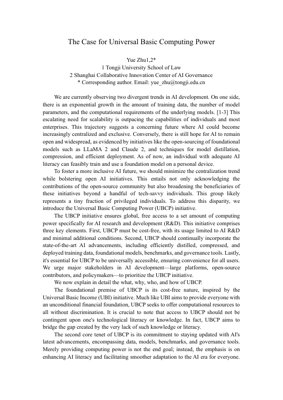
The paper "The Case for Universal Basic Computing Power" identifies a critical divergence in contemporary AI development: the trend towards resource-intensive, centralized models controlled by few entities, versus the potential for open, democratized AI enabled by initiatives like model open-sourcing and efficient deployment techniques. The author argues that to ensure an inclusive AI future, we must actively counter centralization by broadening access to the fundamental resource underpinning AI advancement: computing power.
This leads to the proposal of Universal Basic Computing Power (UBCP), a policy initiative designed to guarantee global, free access to a baseline amount of computational resources specifically dedicated to AI research and development (R&D). The concept is framed as a digital-age parallel to Universal Basic Income (UBI), aiming to provide an unconditional foundation for participation in the AI-driven economy.
Key Insights
- Centralization Risk: Exponential growth in data, parameters, and compute requirements is creating a high barrier to entry, risking an AI future controlled by a handful of large corporations or states.
- Open Source as Counterweight: Initiatives like LLaMA 2 and Claude 2 open-sourcing demonstrate a viable path towards democratization, but their benefits are currently limited to a technologically privileged minority.
- UBCP as a Solution: A guaranteed, free allocation of computing power for AI R&D is proposed as a necessary public good to level the playing field and foster widespread innovation.
2. The UBCP Initiative: Core Principles
The UBCP framework is built upon three foundational pillars that define its scope and operational philosophy.
2.1 Cost-Free Access
Inspired by UBI, the foremost principle is that UBCP must be provided unconditionally and free of charge. Access should not be contingent on technical literacy, economic status, or institutional affiliation. The goal is explicitly to bridge the gap created by the lack of such knowledge, making it a tool for empowerment rather than a reward for existing privilege. Usage is strictly limited to AI R&D activities to ensure the resource serves its intended purpose of fostering innovation.
2.2 Integration of State-of-the-Art AI
Merely providing raw compute (e.g., GPU hours) is insufficient. UBCP must be a curated platform that integrates the latest advancements in AI tools and knowledge. This includes:
- Efficiently distilled and compressed foundation models (e.g., smaller variants of large models).
- High-quality, ethically sourced training datasets with comprehensive datasheets.
- Standardized benchmarks for evaluation.
- AI governance and ethics tools (e.g., for bias detection, explainability).
The platform should adopt a low-code/no-code design philosophy, inspired by commercial platforms, allowing users to assemble AI applications from pre-built modules, thereby lowering the skill barrier.
2.3 Universal Accessibility
True universality requires overcoming digital divides. The UBCP interface must be:
- Mobile-first: Fully functional on smartphones, which are the primary internet access point in underserved regions.
- Accessibility-Compliant: Adhering to standards like WCAG to serve users with disabilities.
- Cognitively Inclusive: Employing visualization, animation, and gamification to make complex AI concepts understandable for diverse users, including children and the elderly.
- Localized: Fully translated, with technical terms adapted for global linguistic and cultural contexts.
3. Rationale & Justification
3.1 Human-Centric Benefits
The justification mirrors arguments for UBI, centered on three themes:
- Empowerment: Provides everyone with the means to develop AI literacy and adapt to technological change.
- Individualization: Enables people to tailor AI solutions to their unique local, cultural, or personal needs, moving beyond one-size-fits-all models from centralized providers.
- Autonomy: Reduces dependency on proprietary AI platforms, giving individuals and communities greater control over the technologies that affect their lives.
3.2 Stakeholder Incentives
The paper calls on major stakeholders—large tech platforms, open-source contributors, and policymakers—to support UBCP. For platforms, it can be a form of pre-competitive collaboration that grows the overall market and talent pool. For the open-source community, it provides a massive, engaged user base. For policymakers, it addresses concerns about digital inequality, economic displacement, and technological sovereignty.
4. Technical Framework & Implementation
4.1 Technical Architecture Overview
A potential UBCP system would be a cloud-native platform built on a federated model, possibly leveraging underutilized computing resources from a global network of data centers (similar to the Folding@home concept but for AI). The core architecture would separate the resource provisioning layer from the AI tooling and user interface layer.
4.2 Mathematical Model for Resource Allocation
A fair allocation mechanism is critical. One model could be based on a time-sliced, priority-queue system. Each user i receives a recurring allocation of "compute credits" $C_i(t)$ per time period $t$ (e.g., monthly). When a user submits a job with estimated compute cost $E_j$, it enters a queue. The system aims to maximize total utility subject to a global budget $B$.
A simplified objective function for scheduling could be:
$\text{Maximize } \sum_{j} U_j(E_j, p_j) \cdot x_j$
$\text{Subject to: } \sum_{j} E_j \cdot x_j \leq B$
Where $U_j$ is the utility function for job $j$ (which could factor in user priority $p_j$, perhaps inversely related to past usage to promote equity), and $x_j$ is a binary variable indicating if the job is run.
4.3 Prototype Performance & Simulated Results
While no full-scale UBCP exists, simulations based on cloud pricing and open-source model requirements can be illustrative. For example, providing each global user with a monthly quota capable of fine-tuning a medium-sized language model (e.g., 7B parameters) on a modest dataset would require massive infrastructure. Preliminary modeling suggests a non-linear scaling of cost vs. user benefit.
Simulated Chart Description: A line chart showing "Cumulative Societal Innovation Benefit (Indexed)" on the Y-axis against "Aggregate UBCP Compute Budget (PetaFLOP/s-days)" on the X-axis. The curve is initially shallow, representing basic access and literacy gains, then rises steeply in a "critical mass" zone where users can perform meaningful R&D, before plateauing as marginal returns diminish for very high allocations. The chart highlights the need to target the budget to reach the inflection point of the curve.
5. Analysis Framework: A Case Study
Scenario: A public health researcher in a low-income region wants to develop a diagnostic AI tool for a local disease using medical imaging, but lacks computational resources and deep learning expertise.
UBCP Application:
- Access: The researcher logs into the UBCP portal via a smartphone.
- Tool Selection: Uses a low-code interface to select a pre-trained, medically-oriented vision foundation model (e.g., a distilled version of a model like PubMedCLIP) and connects it to a model fine-tuning module.
- Data & Compute: Uploads a small, anonymized dataset of local images. The platform's governance tools help create a datasheet. The researcher allocates their monthly compute credits to the fine-tuning job.
- Development & Evaluation: The job runs on federated infrastructure. The platform provides standardized medical imaging benchmarks for evaluation. The researcher iterates on the model using an intuitive visual dashboard.
- Outcome: A locally relevant, customized diagnostic tool is created without upfront investment in hardware or advanced AI skills, demonstrating UBCP's empowerment potential.
6. Future Applications & Development Roadmap
Short-term (1-3 years): Pilot programs in academic or NGO settings, focusing on providing access to students and researchers in developing regions. Integration with existing educational platforms (e.g., Coursera, edX AI courses) to provide hands-on compute.
Medium-term (3-7 years): Establishment of national or regional UBCP funds, potentially financed by a levy on commercial AI compute usage or as part of digital public infrastructure initiatives. Development of robust, sandboxed environments for safe AI experimentation.
Long-term (7+ years): UBCP as a globally recognized digital right, integrated into international frameworks. Evolution of the platform to support decentralized AI training and federated learning at scale, enabling collaborative model development without central data pooling. Potential convergence with decentralized physical infrastructure (DePIN) networks for compute sourcing.
7. Critical Analysis & Expert Commentary
Core Insight: Zhu's UBCP proposal is not just a technical fix; it's a profound political and economic intervention aimed at preempting a "compute aristocracy." It correctly identifies compute access, not just algorithms or data, as the new frontier of inequality. The analogy to UBI is apt but understates the complexity—while money is fungible, compute must be intelligently packaged with tools and knowledge to be useful, making UBCP a far more intricate public good.
Logical Flow: The argument follows a compelling, three-act structure: (1) Diagnose the problem (centralization via compute scaling laws), (2) Propose the solution (UBCP's three pillars), (3) Appeal for action (call to stakeholders). The logic is sound, but it glosses over the monumental governance challenges—who decides what models are "state-of-the-art" on the platform? How is "AI R&D" defined versus prohibited use? These are non-trivial political questions, not technical ones.
Strengths & Flaws:
Strengths: The paper's greatest strength is its timely and ambitious vision. It moves beyond hand-wringing about AI ethics to a concrete, resource-based proposal. The emphasis on mobile accessibility and localization shows deep understanding of real-world digital divides. The call to integrate tools, not just raw cycles, aligns with research from the Stanford Institute for Human-Centered AI (HAI), which stresses the importance of usability and education in democratization.
Flaws: The elephant in the room is funding and sustainability. The paper is silent on the estimated cost, which would be astronomical for a global rollout. Unlike UBI, where cash transfers have clear economic multipliers, the return on investment for universal compute is harder to quantify. Furthermore, the risk of the platform itself becoming a new centralizing force or a target for malicious use (e.g., generating disinformation) is not adequately addressed. Proposals like UBCP must learn from the governance challenges faced by large-scale cyberinfrastructure projects like the XSEDE network.
Actionable Insights: For policymakers, the immediate step is not a global UBCP, but "UBCP-Lite" pilots: publicly-funded AI compute clouds for academic and civic institutions, with strong educational wrappers. For tech firms, the insight is to view contributions to such pools not as charity but as strategic ecosystem investment—much like Google's TPU Research Cloud or OpenAI's earlier API credits for researchers. The open-source community should champion standards for portable, efficient AI workloads that can run across heterogeneous hardware, making a future UBCP technically feasible. Ultimately, Zhu's paper should be read as a provocation: we are designing the political economy of AI right now, and if we don't consciously build mechanisms for broad-based access, we will inevitably cement a new form of technological oligarchy.
8. References
- Zhu, Y. (2023). The Case for Universal Basic Computing Power. Tongji University. [Source PDF]
- Kaplan, J., et al. (2020). Scaling Laws for Neural Language Models. arXiv:2001.08361.
- Bommasani, R., et al. (2021). On the Opportunities and Risks of Foundation Models. Stanford Center for Research on Foundation Models (CRFM).
- Gebru, T., et al. (2021). Datasheets for Datasets. Communications of the ACM.
- Mitchell, M., et al. (2019). Model Cards for Model Reporting. Proceedings of the Conference on Fairness, Accountability, and Transparency (FAT*).
- Van Parijs, P., & Vanderborght, Y. (2017). Basic Income: A Radical Proposal for a Free Society and a Sane Economy. Harvard University Press.
- Stanford Institute for Human-Centered AI (HAI). (2023). The AI Index Report. https://aiindex.stanford.edu/
- XSEDE: Extreme Science and Engineering Discovery Environment. https://www.xsede.org/